Cost-Effective Solution for Refinery
Cooling Towers
Background
A major oil refinery in the western United States,
a long-time Philadelphia Gear customer, had developed a problem
over the course of the last 10 to 15 years. They had replaced a
number of cooling
tower drives, and were accumulating the used ones on-site, with
no clear idea as to their final use. Should they be rebuilt? Scrapped?
Or perhaps replaced and put back into storage?
The oil refinery used their cooling tower drives to
chill condensed steam generated by the manufacturing processes -
typically about 10 units at any given time. These are closed-loop
systems, so the steam temperature must be lowered prior to it being
reintroduced into the production cycle.
Over this same 10 to 15 year period, the refinery
had gone through a protracted downsizing effort. They no longer
had the resources to inspect and repair the drives on-site, and
hadn't made the decision to have them inspected/repaired by an outside
service provider. Thus, when a unit failed, a new one was purchased
and the old one was simply put off to the side. These old units
began to accumulate.
Lack of accessibility to the cooling tower
drives (due to the average elevation of a cooling tower often
exceeding 80 feet) led to poor-to-nonexistent preventative
maintenance procedures. Compounding the problem, safety concerns
did not allow for inspection of the units while they were
running, and the refinery was reluctant to shut units down
during the manufacturing process. Consequently, this affected
the inspect/repair procedures negatively and tended to leave
cooling tower drive failures a mystery.
The Problem
On a routine visit by a Philadelphia Gear sales representative,
the customer inquired about purchasing new units to replace
some of their aging models. The customer had three different
manufacturer's drives in use. Several of the cooling tower
drives had either become noisy, or were above acceptable vibration
thresholds.
Rather than quoting on new equipment, the
representative opted for a visual
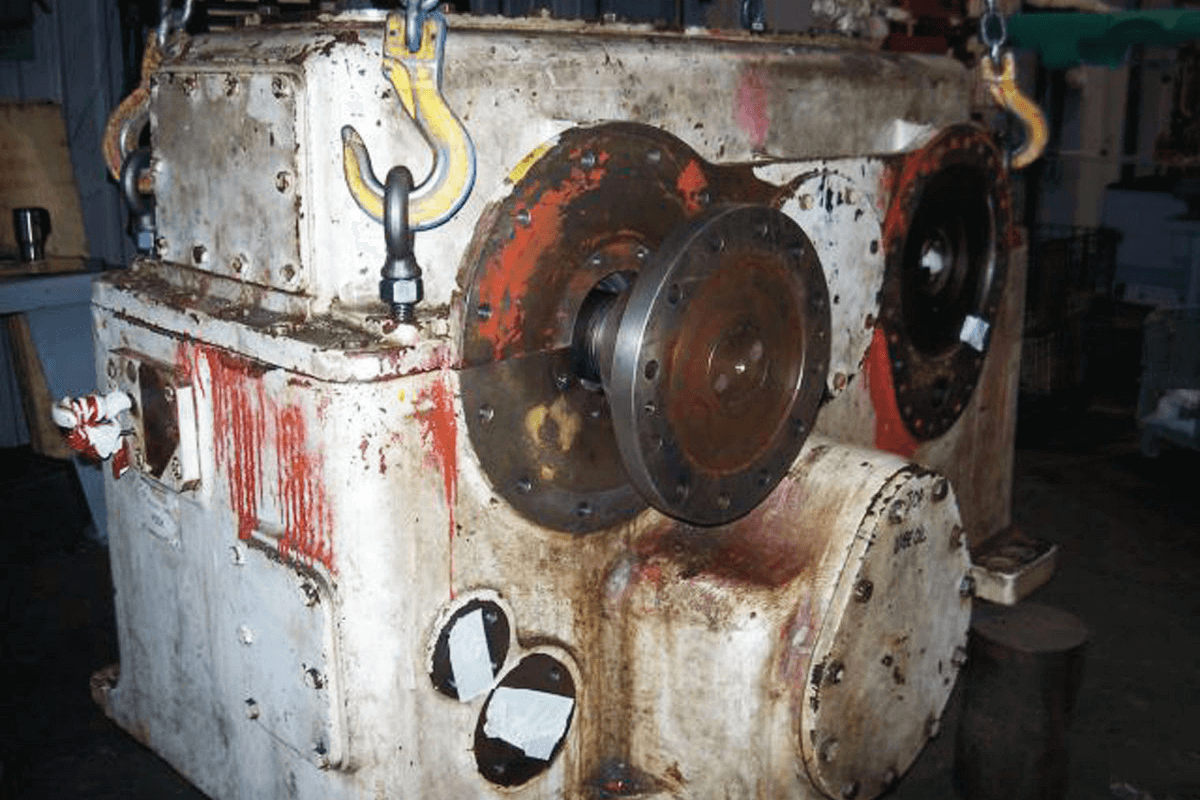
inspection of four units that had been shelved during
the downsizing period. Even though none of these four were
Philadelphia Gear drives, he concluded that the units could
still be salvaged, and sent them to the Houston
Regional Service Center for a complete inspection. The
customer decided to wait for the results before having the
new drives quoted.
The Solution
All four enclosed cooling tower drives were sent to Houston
for cost/benefit analysis on repair versus new. The units
underwent the following
procedures:
• Disassembly, cleaning and inspection
• Magnetic particle inspection of all gear elements
and housing (a sophisticated black light test revealing pits,
cracks, etc.)
• Dimensional inspection of housing
• Visual inspection of rotating elements (gears,
shafts and bearings) to evaluate level of deterioration
Test results determined that by combining
components of the four boxes, Philadelphia Gear could actually
recondition them into two useable units. By taking this approach,
the refinery was able to save 40% of the cost that would have
been spent on new units.
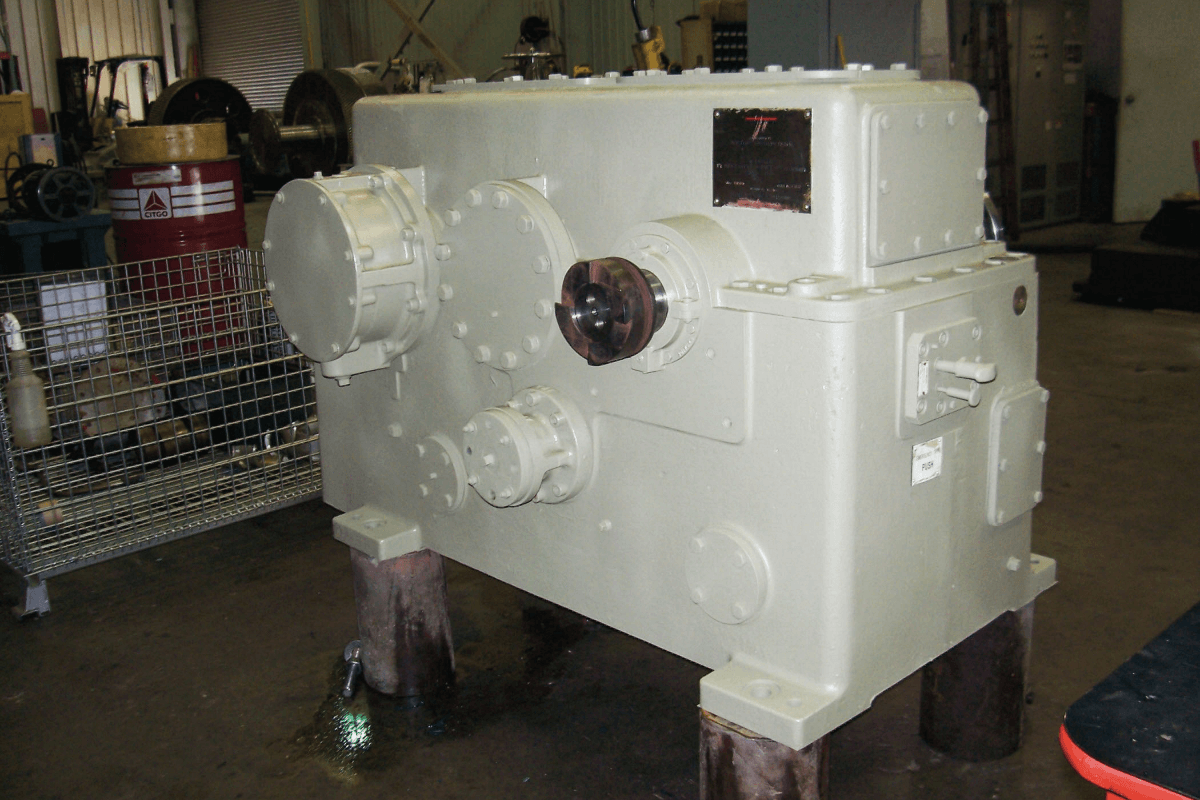
Once authorization to proceed was secured, the
parts to be reused were cleaned and the housing was sandblasted
and painted; bearing caps were re-machined as needed; no-load,
full speed spin tests were conducted; and vibration, noise,
and temperature levels were measured and recorded. A job of
this magnitude typically takes six weeks, but the two reconditioned
units were shipped back to the customer to re-install on-site
in just four. All work included Philadelphia Gear's "best
in industry" one year warranty - which includes a
six month grace period to actually re-install the unit.